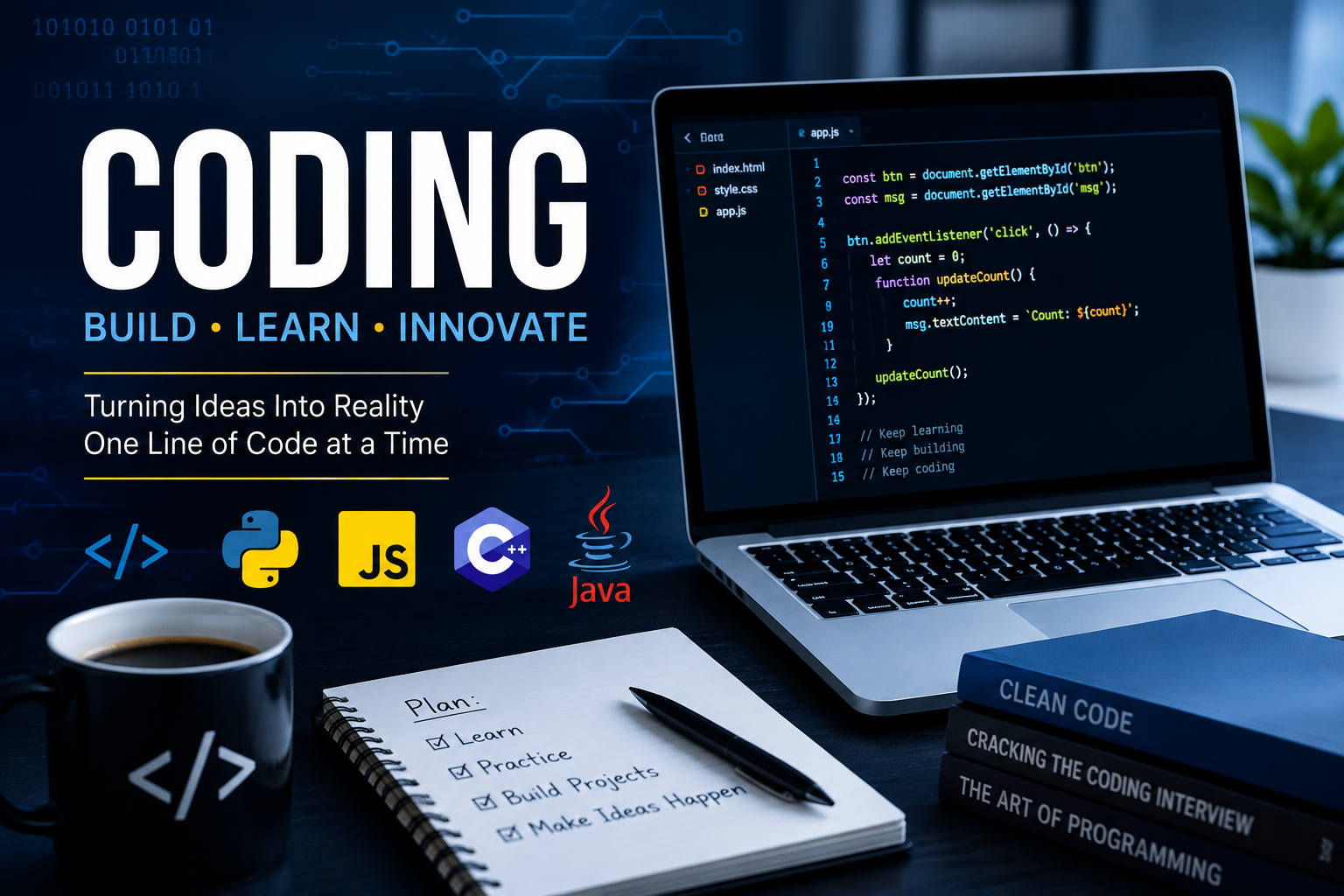
Coding has become one of the most valuable skills in the modern digital world. From mobile apps and websites to artificial intelligence, games, banking systems, and smart devices, coding is behind much of the technology we use every day.
Whether you want to become a professional developer or simply understand how technology works, learning to code can open many exciting opportunities.
What Is Coding?
Coding is the process of writing instructions that computers can understand and execute. These instructions are written using programming languages such as Python, JavaScript, Java, C++, and many others.
Every application or digital service follows instructions. When you click a button on a website, send a message through an app, or search for information online, computer code helps make that action possible.
Why Learn Coding?
One of the biggest advantages of coding is that it develops problem-solving skills. Programmers learn to break complicated problems into smaller, manageable steps.
Coding can also provide excellent career opportunities. Businesses in almost every industry need people who can build websites, develop software, analyze data, maintain digital systems, and work with emerging technologies.
Another benefit is creativity. Coding is not only about numbers and technical instructions. It allows you to turn ideas into real projects. You can create a personal website, build a mobile application, develop a game, or automate repetitive tasks.
Popular Programming Languages
Different programming languages are designed for different purposes.
Python is one of the most beginner-friendly languages. It is widely used for web development, data analysis, automation, artificial intelligence, and machine learning.
JavaScript is essential for modern web development. It allows developers to create interactive websites and web applications.
Java is widely used for enterprise software and Android-related development.
C++ is commonly used when performance is important, including game development and system-level programming.
Beginners should choose a language based on their goals rather than trying to learn everything at once.
How to Start Learning Coding
Starting with coding can seem difficult, but the learning process becomes easier when approached step by step.
First, choose one programming language. Python is often a good starting point because its syntax is relatively simple.
Next, learn the fundamentals. Focus on variables, data types, conditions, loops, functions, and basic data structures.
Practice is extremely important. Reading tutorials alone will not make you a programmer. Write small programs and experiment with different ideas.
For example, beginners can create a calculator, number-guessing game, simple quiz, personal webpage, or to-do application. These projects help turn theoretical knowledge into practical experience.
The Importance of Problem Solving
Good programmers are not people who remember every command. They are people who know how to solve problems.
When a program does not work, instead of becoming frustrated, try to understand what went wrong. Read error messages, test small sections of code, search documentation, and experiment with possible solutions.
Debugging is an important part of programming. Even experienced developers encounter errors, so learning how to find and fix them is an essential skill.
Coding and the Future
Technology continues to evolve rapidly, creating new opportunities for programmers. Artificial intelligence, cloud computing, cybersecurity, robotics, data science, and software development are changing the way businesses operate.
Learning coding can therefore provide a strong foundation for adapting to future technologies. Even as development tools become more automated, understanding programming concepts can help people use those tools effectively and responsibly.
Tips for Successful Learning
Set realistic learning goals instead of trying to master coding in a few days. Spend a little time practicing regularly and gradually increase the difficulty of your projects.
Do not be afraid of mistakes. Errors are part of the learning process. Try to understand why something failed instead of simply copying a solution.
It is also useful to read other people's code and participate in programming communities. Learning from different approaches can improve your understanding and introduce you to new techniques.
Conclusion
Coding is more than writing computer instructions. It is a way of thinking, solving problems, and transforming ideas into useful digital products.
With patience, consistent practice, and hands-on projects, anyone can begin learning the fundamentals of programming. You do not need to know everything before you start. Begin with one language, build small projects, learn from your mistakes, and keep improving.
The first line of code may seem small, but it can be the beginning of an exciting journey into the world of technology.