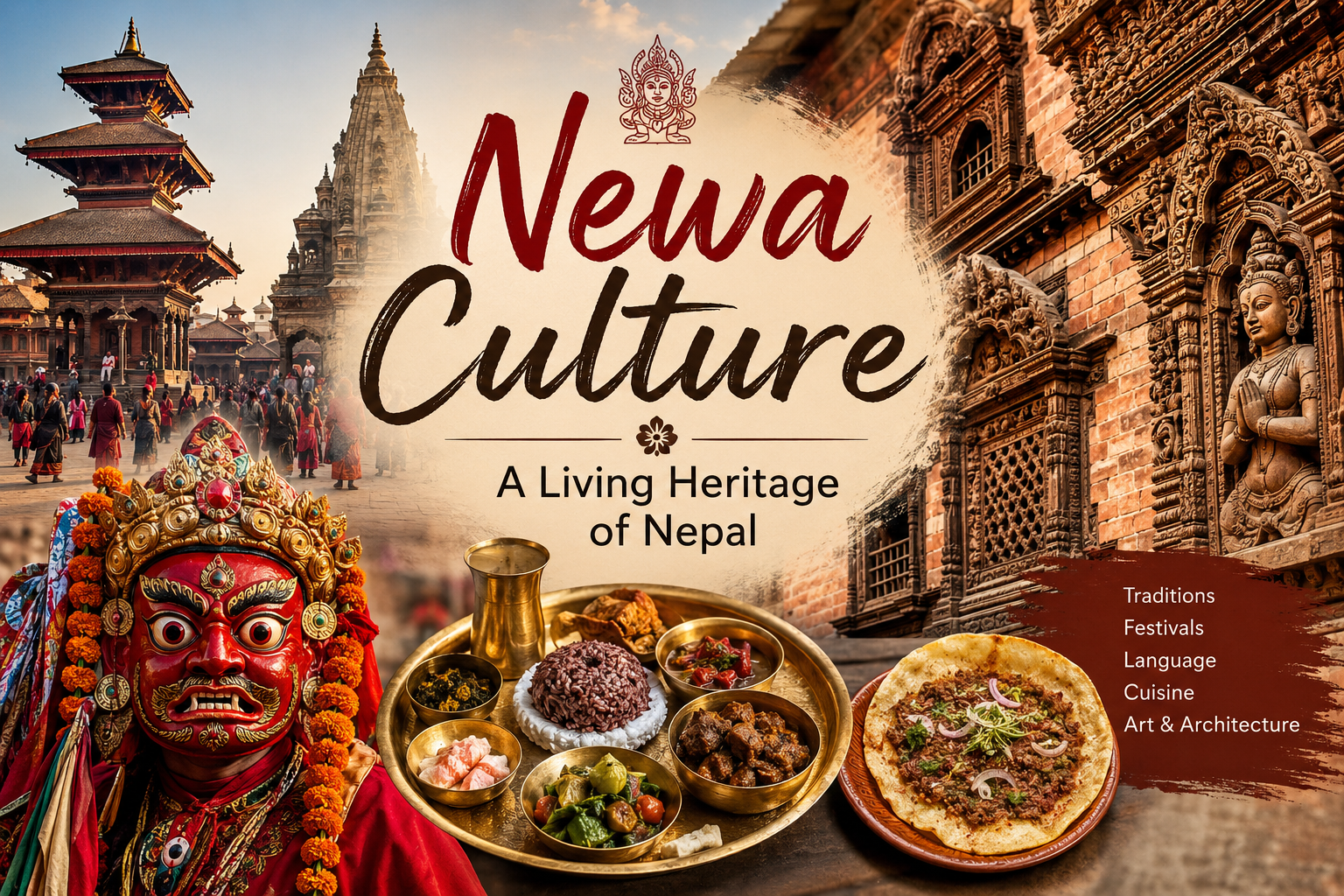
Newa culture is one of the most fascinating and distinctive cultural traditions of Nepal. Closely connected with the historic Kathmandu Valley, Newa heritage can be seen in its architecture, language, festivals, food, art, music, religious traditions, and community life. The Newa people have contributed greatly to the cultural identity of Nepal, creating a heritage that continues to influence everyday life as well as tourism, art, and history.
A Rich Cultural Heritage
Newa culture is not simply a collection of old traditions. It is a living heritage passed from one generation to another. Historic cities such as Kathmandu, Lalitpur, and Bhaktapur contain many temples, courtyards, monasteries, traditional houses, and public spaces that reflect Newa craftsmanship and urban traditions.
Traditional Newa architecture is particularly famous for its detailed wood carvings, brick buildings, decorated windows, courtyards, and religious structures. Walking through the older parts of the Kathmandu Valley can feel like entering an open-air museum where history and modern life exist side by side.
Newa communities have also played an important role in preserving traditional arts and craftsmanship. Wood carving, metalwork, stone carving, painting, sculpture, and traditional architecture remain important parts of the cultural heritage.
Festivals and Traditions
Festivals are at the heart of Newa cultural life. Throughout the year, communities celebrate numerous festivals and ceremonies that bring families and neighborhoods together. These occasions are not only religious events but also opportunities to strengthen community relationships and preserve traditions.
Festivals such as Mha Puja, Indra Jatra, and various local jatras are associated with distinctive rituals, music, processions, and traditional foods. Mha Puja, for example, emphasizes the importance of the individual and is celebrated as a ceremony of self-purification and appreciation.
Community organizations and traditional social institutions have historically helped organize festivals, maintain religious sites, and support community activities. This collective approach has helped Newa traditions survive through changing times.
Nepal Bhasa: The Language of Heritage
Language is another important part of Newa identity. Nepal Bhasa, also commonly referred to as Newari, is traditionally associated with the Newa community. It has a long literary and cultural history and remains an important symbol of identity.
Today, preserving Nepal Bhasa is especially important because languages can become vulnerable when younger generations increasingly use dominant languages. Recent research has also highlighted the limited availability of digital language resources for Nepal Bhasa, showing why digitization, education, documentation, and modern technology can play an important role in preserving the language.
Teaching children traditional vocabulary, encouraging literature, producing digital content, and supporting cultural publications can help ensure that the language remains part of future generations.
The Taste of Newa Cuisine
Newa cuisine is another remarkable part of the culture. Food is closely connected with festivals, ceremonies, family gatherings, and social occasions. Traditional Newa meals offer a wide variety of flavors, ingredients, and cooking methods.
Popular dishes include bara, chatamari, choila, yomari, kwati, and samay baji. These foods are more than delicious meals; they often carry cultural and ceremonial meaning. Traditional Newa feasts, known as bhoj, bring people together and provide an important way of sharing culture with younger generations.
Newa cuisine has also attracted visitors interested in experiencing authentic food from the Kathmandu Valley. Its popularity demonstrates how traditional food can become an important form of cultural tourism while remaining connected to community identity.
Art, Music, and Craftsmanship
Newa artistic traditions are widely admired for their detail and creativity. Traditional paintings, sculptures, masks, musical instruments, metal statues, and architectural decorations demonstrate generations of craftsmanship.
Music and dance are also closely connected with festivals and religious ceremonies. Traditional instruments and performances help create the atmosphere of community celebrations and provide a link between the present and the past.
For young people, learning these traditional skills can be a meaningful way to connect with their heritage. At the same time, modern artists can reinterpret traditional Newa designs through contemporary art, fashion, architecture, and digital media.
Preserving Newa Culture in the Modern World
Like many traditional cultures, Newa heritage faces challenges from urbanization, modernization, changing lifestyles, and the gradual loss of traditional knowledge. Historic neighborhoods are changing, traditional buildings require conservation, and younger generations may have fewer opportunities to learn old customs.
However, modernization does not have to mean abandoning tradition. New technology can actually provide new opportunities for cultural preservation. Websites, blogs, social media, online dictionaries, digital archives, videos, podcasts, and educational platforms can introduce Newa culture to audiences around the world.
Cultural tourism can also support preservation when it is respectful and community-centered. Visitors can learn about traditional architecture, festivals, food, crafts, and history while supporting local artists and businesses.
Conclusion
Newa culture is a beautiful example of how history can remain alive through everyday life. Its architecture tells stories through carved wood and brick; its festivals bring communities together; its language preserves memories; its food connects families; and its arts demonstrate generations of creativity.
Preserving Newa heritage is not only the responsibility of older generations. Young people, educators, artists, researchers, cultural organizations, and digital creators all have a role to play.
The future of Newa culture depends on keeping its traditions meaningful while allowing them to evolve naturally. By documenting its history, teaching its language, celebrating its festivals, supporting traditional crafts, and sharing its stories with the wider world, we can help ensure that this remarkable heritage continues to thrive for generations to come.